 Learn hubBlog
Break down COIN ML — margin loans of a coin on Binance spot: what the numbers are, all twelve fields and what they reveal.
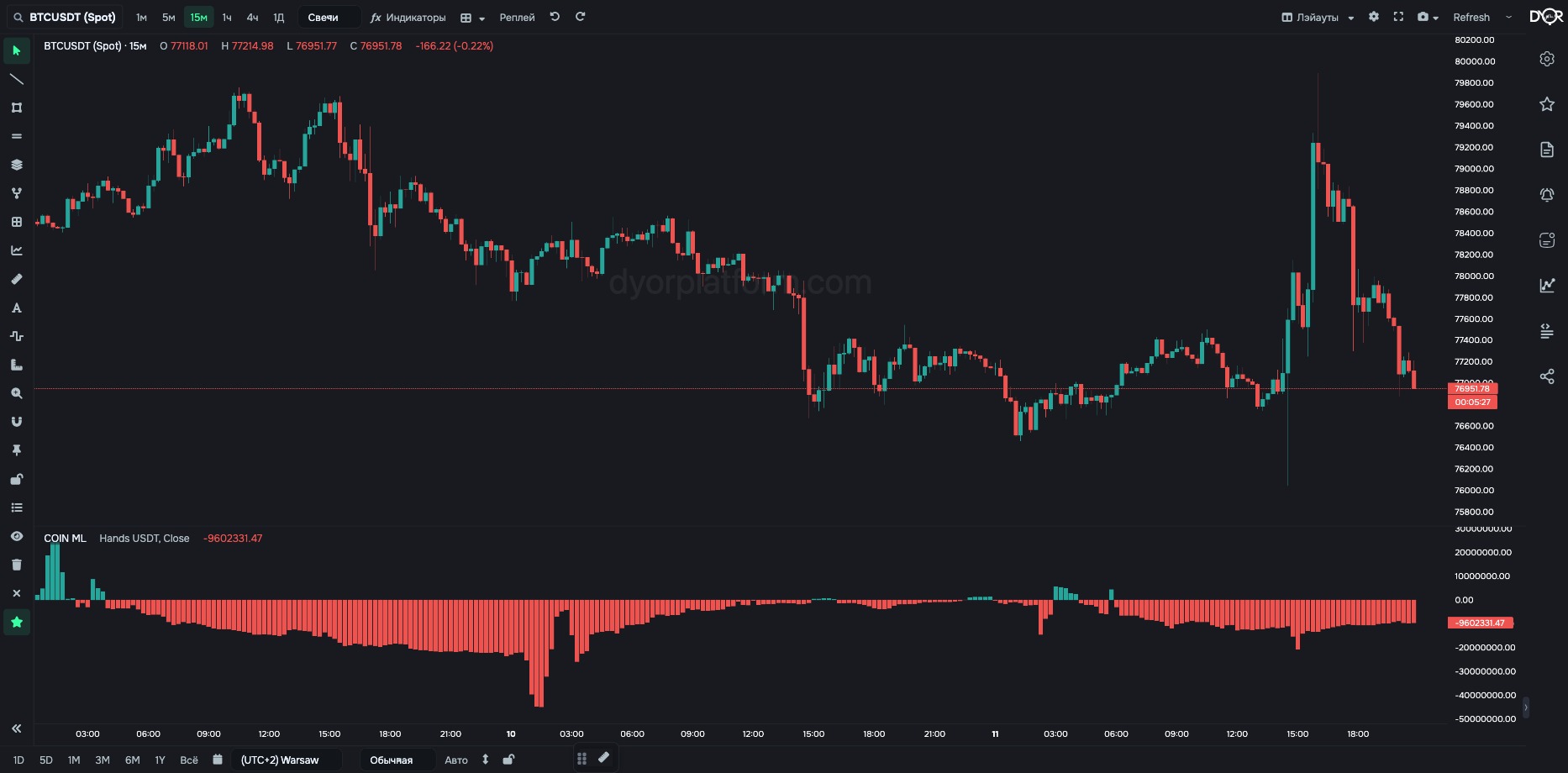
Margin loans of the coin on Binance spot.
What it is. The exchange lends the coin against collateral. A coin is usually borrowed to be sold: that is a short on spot. If price falls, the coin is bought back cheaper and the loan is repaid. A stablecoin is borrowed to buy a coin: that is a long on credit, and ML STABLECOIN shows it.
An example. A trader expects BTC to fall. He has $100,000 in USDT and no bitcoin. He posts the USDT as collateral and borrows 1 BTC from the exchange at 84,000.
One trader — 1 BTC. On the chart — thousands like him. Hands USDT +$5M — over the last 24 hours $5M more was borrowed than repaid: the coin is being sold on credit. Hands −$5M — $5M more was repaid: the coin is being bought back. How much was borrowed and repaid in this particular bar — Delta USDT. After 24 hours our trader's loan leaves the window: Borrowed and Hands drop by 1 BTC on their own, but Delta will not show that — it counts only real borrowing and repayments.
Where the numbers come from. For each coin the exchange publishes three numbers: how much was borrowed and how much repaid over the last 24 hours, and how much more can be borrowed. The window is rolling, the exchange recalculates it every 5 minutes, there is no reset at midnight. The platform takes the numbers every minute, and a bar on the chart is the average of the minute snapshots. Delta is calculated differently: from the rolling sums it reconstructs how much was actually borrowed and repaid within the bar.
See the spot short that futures indicators do not show: the coin is borrowed to be sold. And see when that short gets closed — and it can only be closed by buying.
For example.
Metric — twelve fields, in three groups of four.
1. What there is.
2. The difference.
3. Movement over time.
In coins or in dollars. With the USDT tag — at the price at the time of the snapshot, so when price rises the dollar line rises by itself. In coins, price does not interfere: you see the loans themselves. Compare coins with each other in dollars, read a single coin in coins.
CD Mode — only for Cumulative Delta. There are several minute values inside a bar: Close — at the end of the bar, Open — at the start, High and Low — the extremes, Average — the mean.
Example on BTC, 23.09. Over the last 24 hours Borrowed 745 BTC, Repaid 758 → Hands −12.6 BTC, that is −$1.1M, Loan Coefficient −0.017: over the day slightly more was repaid than borrowed. In USDT at the same hour: Borrowed $840M, Repaid $1.14B → Hands −$299M, coefficient −0.36: the dollar debt was being paid off over the day.
The takeaway from these two lines. The BTC short on credit barely changes — minus 12 BTC against 745 borrowed is noise. But the credit long is being unwound noticeably: $299M more was repaid than borrowed, a third of the borrowed amount. To repay dollars, coins are usually sold — so part of the spot selling was driven not by choice but by debt. The same negative number on COIN ML and on ML STABLECOIN means different things: for the coin — buying back, for the stablecoin — selling.
| Field | Options | Default | What it changes |
|---|---|---|---|
| Metric | Hands Amount Hands USDT Loan Coefficient Available Borrowed Repaid Borrowed USDT Repaid USDT Delta Delta USDT Cumulative Delta Cumulative Delta USDT | Hands USDT | Which field to show. Each one is covered in “Settings in detail” above. In short: Borrowed / Repaid — borrowed and repaid over the last 24 hours. Hands — their difference, net over 24 hours. Loan Coefficient — Hands ÷ Borrowed. Available — how much more can be borrowed. Delta — net loan flow per bar: actually borrowed minus actually repaid. Cumulative Delta — cumulative net flow. With the USDT tag — in dollars, without it — in coins. - Want the picture from the exchange data, borrowing or repaying — Hands USDT. - Want the flow for each bar specifically — Delta USDT. - Want the cumulative picture, debt piling up or being paid off — Cumulative Delta USDT. - Want to know whether there is anything left to borrow — Available. |
| CD Mode | Open High Low Close Average | Close | Applies only to Cumulative Delta. There are several minute values inside a bar — which one to show: Close — at the end of the bar. High or Low — the extreme inside the bar, if you want to see peaks. Average — the bar average, smoother. Open — at the start of the bar. |
Metric COIN ML. Condition fields:
Market Type — SPOT only.
TOTAL ML — loans across the whole market. Metrics: Hands USDT, Borrowed USDT, Repaid USDT, Available, Coins Count, Delta USDT, Cumulative Delta USDT.
COIN ML — coin loans on spot: borrowed, repaid, the free pool. By default Hands USDT — borrowed minus repaid over the last 24 hours: plus — debt grows, the coin is being sold on credit; minus — debt is being paid off, the coin is being bought back. Delta — net loan flow per bar, Cumulative Delta — cumulative flow, watch the slope. A coin is borrowed to sell, a stablecoin to buy: that is why COIN ML mirrors ML STABLECOIN.
Hands USDT = −$1M means…
Correct answer: $1M more was repaid than borrowed: debt is being paid off
Hands USDT = −$50M. What happened over the last 24 hours?
Correct answer: $50M more dollars were repaid than borrowed