 Learn hubBlog
Cover COIN OI — open interest of perpetual futures on Binance, Hyperliquid and Deribit, and how it differs from volume.
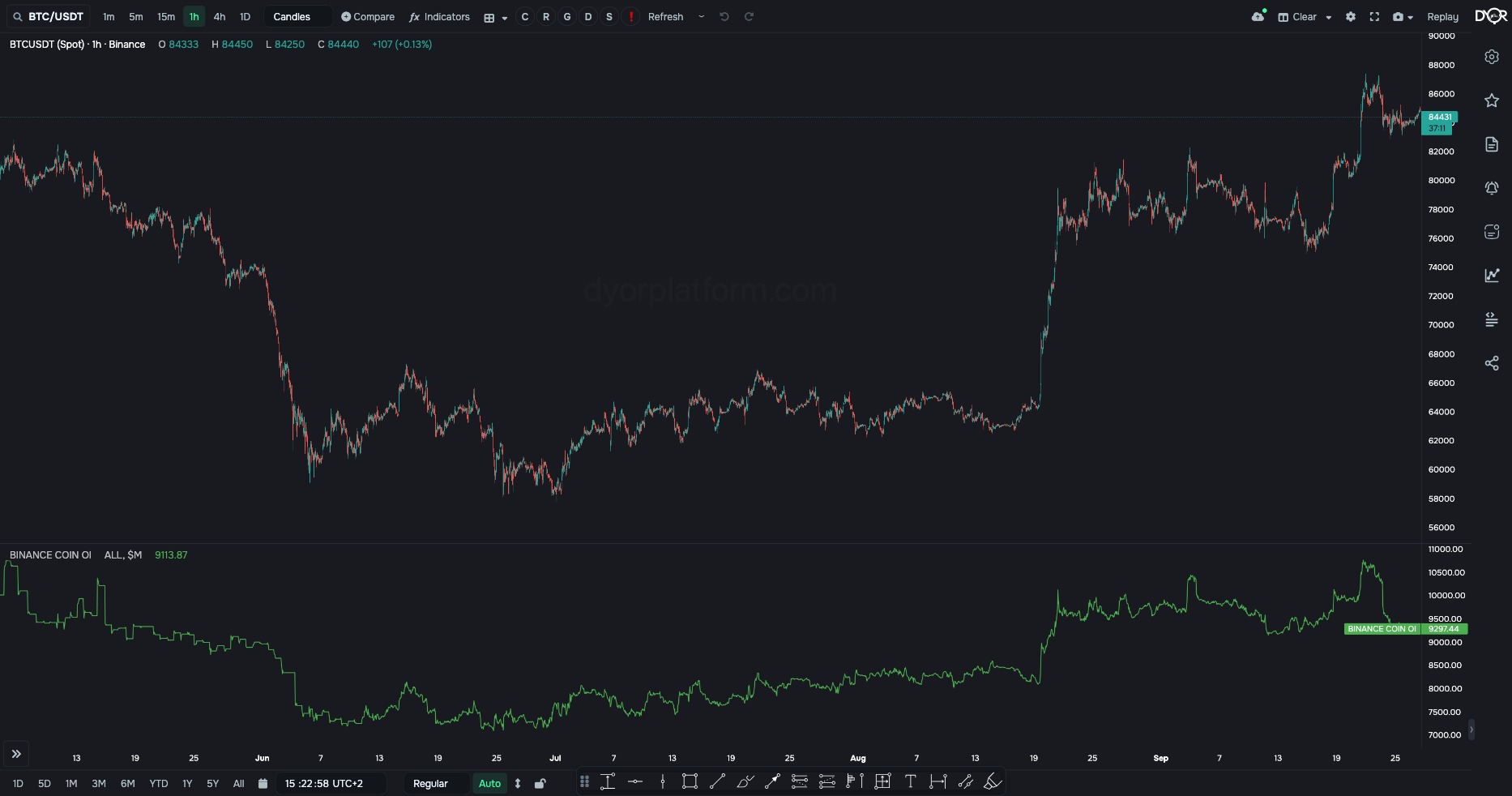
Open interest (OI) of perpetual futures for the coin. It is the sum of all open positions right now, in millions of dollars. Exchanges: Binance, Hyperliquid, Deribit.
How it differs from volume: volume shows how much was traded during the bar. OI shows how much remains open.
What it is made of on Binance. Two perpetual contracts per coin: the USDT contract and COIN-M, where the collateral is the coin itself. The USDC contract and quarterly futures are not included. Services that count only the USDT contract and in coins will show a different number — not an error, a different composition. On Hyperliquid there is one contract. On Deribit BTC and ETH have two separate symbols: the inverse BTC/USD and the linear BTC/USDC, each with its own OI.
Dollars or coins. In dollars, OI rises with the price even if no positions were added. In coins you see the positions themselves: in a rally, OI in dollars can rise while OI in coins falls — positions are being closed, but the dollar value of the rest went up. Units are switched in the settings; the mode is shown in the legend.
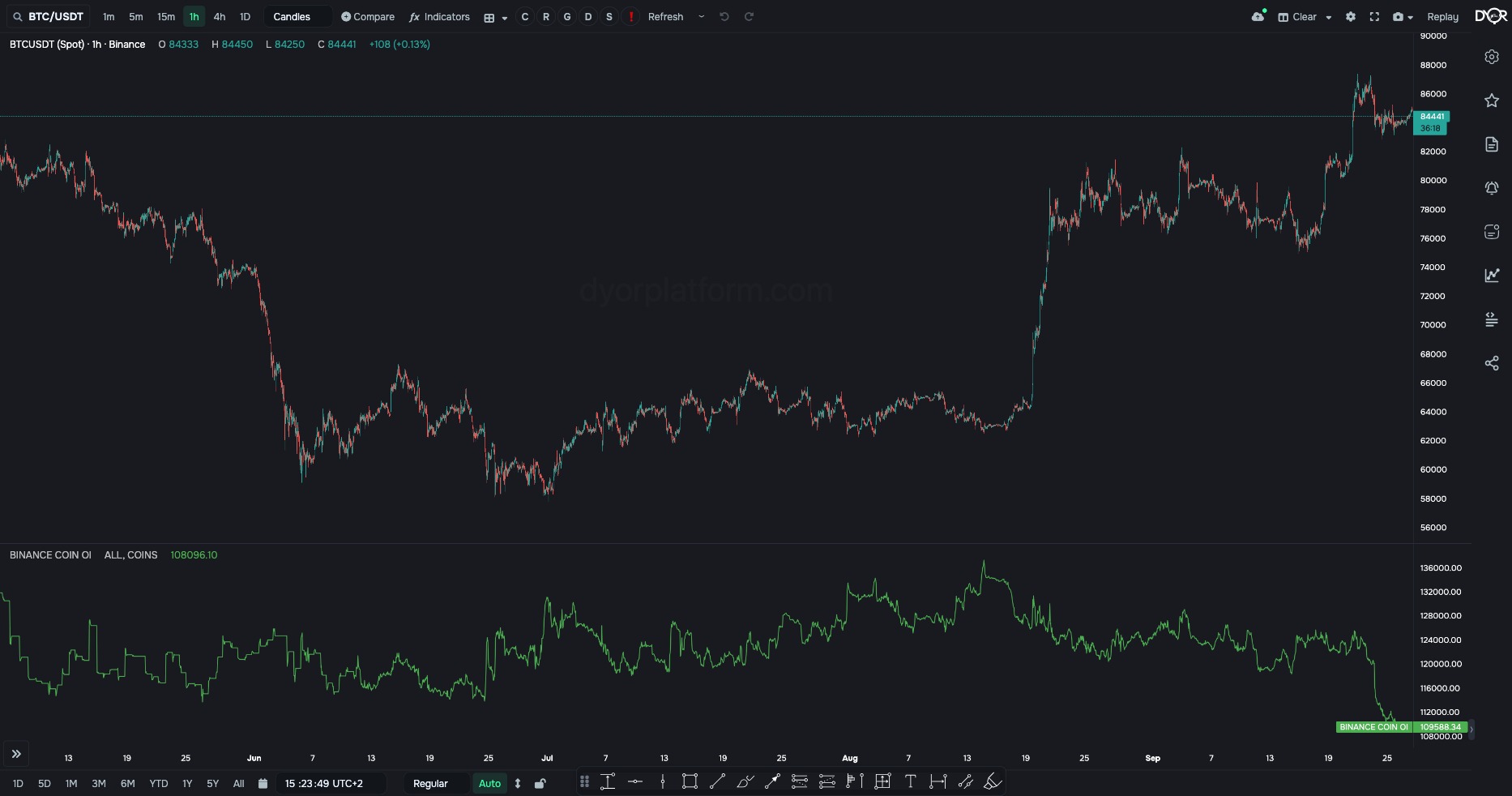
The trap of Deribit inverse contracts. On BTC/USD a contract costs $10, and “coins” are dollars divided by the price. Such a line follows the price, and the rule “coins unaffected by price” does not work there. On inverse contracts look at $M.
See whether money is flowing into futures or out. A price move on new positions and one on old positions closing are different things.
For example.
Data windows. Binance: the “USDT only” and “coins” modes exist from late October 2025, on the 1m timeframe — from 26 September 2026; before those dates the line in the new modes is empty. Hyperliquid: daily OI from June 2023, 1h and 4h — about 180 days, 1m — from 1 October 2026. Deribit: BTC/USD and ETH/USD daily from February 2020, USDC contracts — from 1 October 2026. History before 1 October 2026 for Hyperliquid and Deribit is taken from Coinglass.
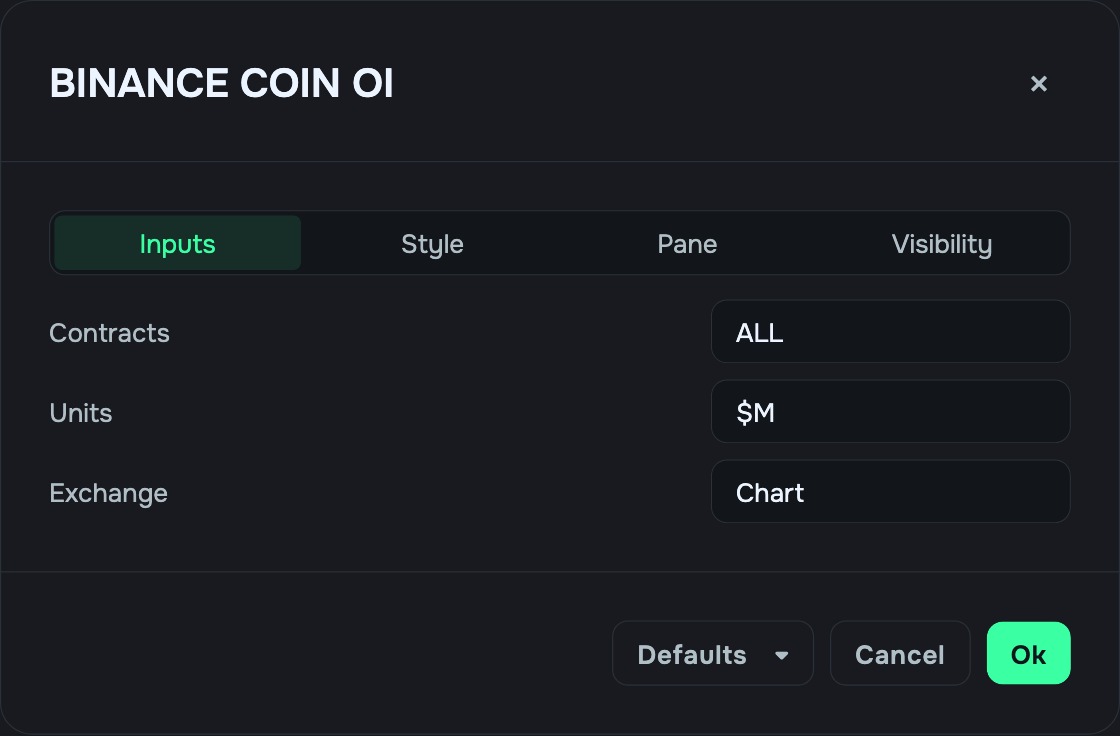
| Field | Options | Default | What it changes |
|---|---|---|---|
| Contracts | ALL USDT only | ALL | ALL — the USDT contract plus COIN-M. USDT only — the USDT contract alone, the way single-contract services count it; handy for cross-checking. Binance only: Hyperliquid and Deribit have one contract. |
| Units | $M COINS | $M | $M — positions at the current price, in millions of dollars. COINS — the number of coins in positions, unaffected by price. - Want to see whether positions are opened or closed — COINS. On Deribit inverse contracts — $M only. |
| Exchange | Chart Binance Hyperliquid Deribit | Chart | Which exchange to take data from: Chart — the same one as the chart. Derivatives exist on Binance, Hyperliquid and Deribit; Coinbase is spot and is not in the list. On Hyperliquid and Deribit funding is hourly. Without a subscription there is no field. |
Metric COIN OI. Condition fields:
Contracts (ALL or USDT only) — Binance only. Units — $M or coins, as on the chart.
TOTAL OI — the sum of OI over all perpetual futures of the exchange. Fields: Exchange (Binance, Hyperliquid, Deribit) and Total Type (TOTAL, TOTAL2, TOTAL3). On Binance quarterly contracts are not included in the sum, so there is no dip on the line on their expiry day. History is exact from 24 March 2026; earlier it is an estimate rescaled with a coefficient, and conclusions should not be built on it. In alerts — the TOTAL OI indicator, fields Exchange, Timeframe, Total type.
OI is the sum of all open futures positions right now. It rises — positions are being opened, falls — closed. A change of position owner does not change OI. On Binance it is counted over two perpetual contracts, in dollars or in coins; “Contracts” works only there. On Deribit inverse contracts look at $M: “coins” there follow the price.
OI rose over the bar — that means…
Correct answer: There are more open positions
The price rose 30%, OI in dollars rose, OI in coins fell. What happened to positions?
Correct answer: Positions were being closed: there are fewer of them, but the dollar value of the rest went up