 Learn hubBlog
Take apart OPTIONS PUT/CALL — the ratio of puts to calls as one number.
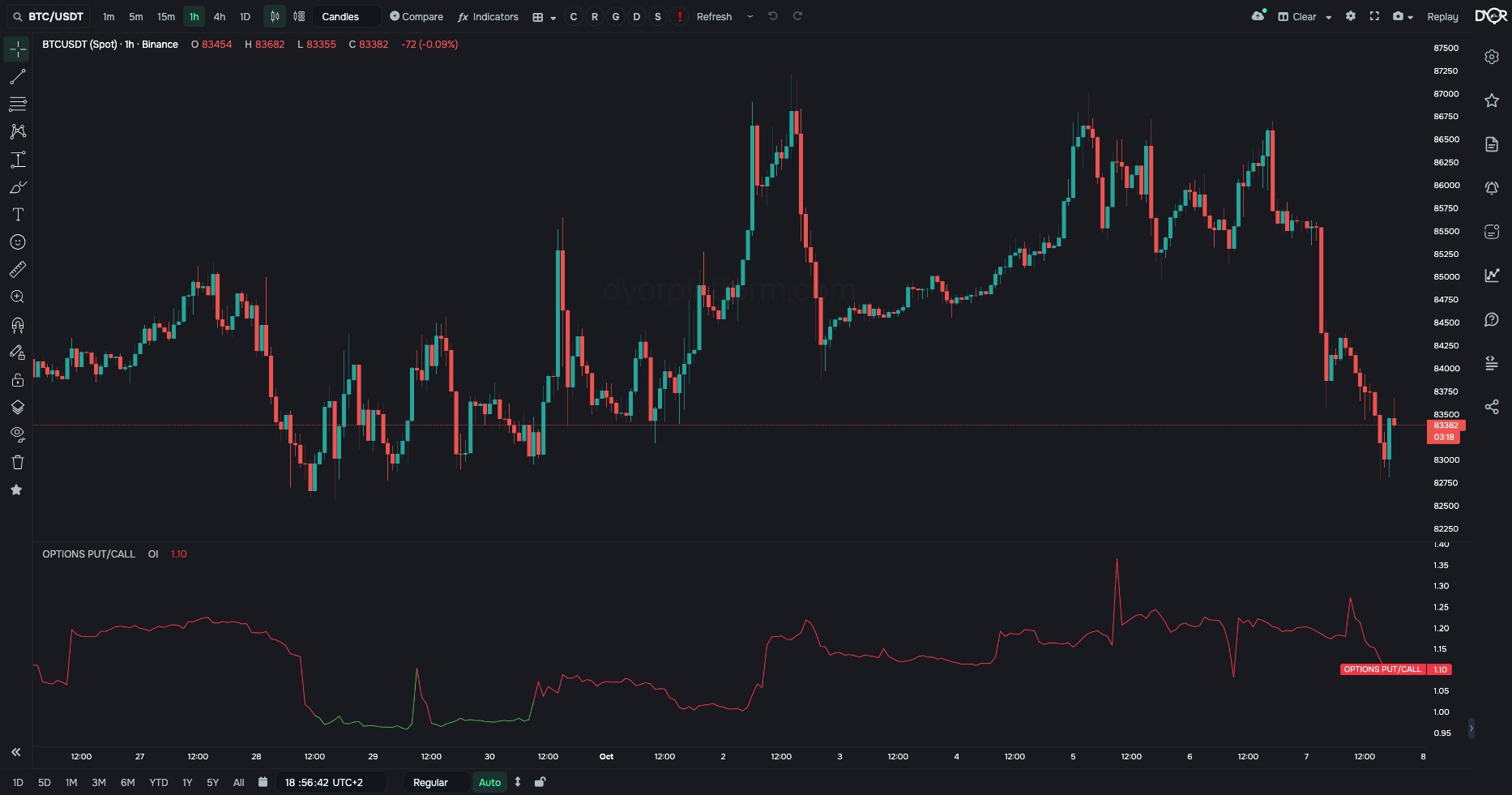
Puts divided by calls. One number.
The number does not say whether puts were bought or sold: every option has both sides. “More puts” does not mean “everyone expects a fall”.
BTC on 1 October 2026, by OI:
Read the balance of puts and calls as one number that a threshold can be set on.
For example.
| Field | Options | Default | What it changes |
|---|---|---|---|
| Source | OI Volume | OI | What to count the ratio by. - Want the balance in open contracts, which changes slowly — OI. - Want the balance in this bar’s trades, which jumps around — Volume. |
| Exchange | Chart | Chart | Cannot be switched for options indicators: there are no other values in the list. The options exchange is chosen by the “Options exchange” field below. |
| Options exchange | Binance Deribit | Binance | Whose options to count. The chart’s exchange does not affect this: the indicator takes only the coin from the chart. - Want Binance options — Binance. - Want the main options exchange, with 19 times more BTC open interest — Deribit. |
Metric OPTIONS. Condition fields:
“Options exchange” — Binance or Deribit. “Options metric” for this indicator: Put/Call Ratio (OI) and Put/Call Ratio (Volume). The “Exchange” and “Market type” fields are in the form, but the options asset is taken from the coin.
Above 1 — more puts, below 1 — more calls. Counted by open positions or by volume in the bar. The number does not say whether puts were bought or sold: every contract has two sides.
PUT/CALL = 0.58. What does it mean?
Correct answer: For every 100 open calls there are 58 puts