 Learn hubBlog
Understand BINANCE COIN FUNDING RATE — the funding rate on a perpetual future and who pays whom.
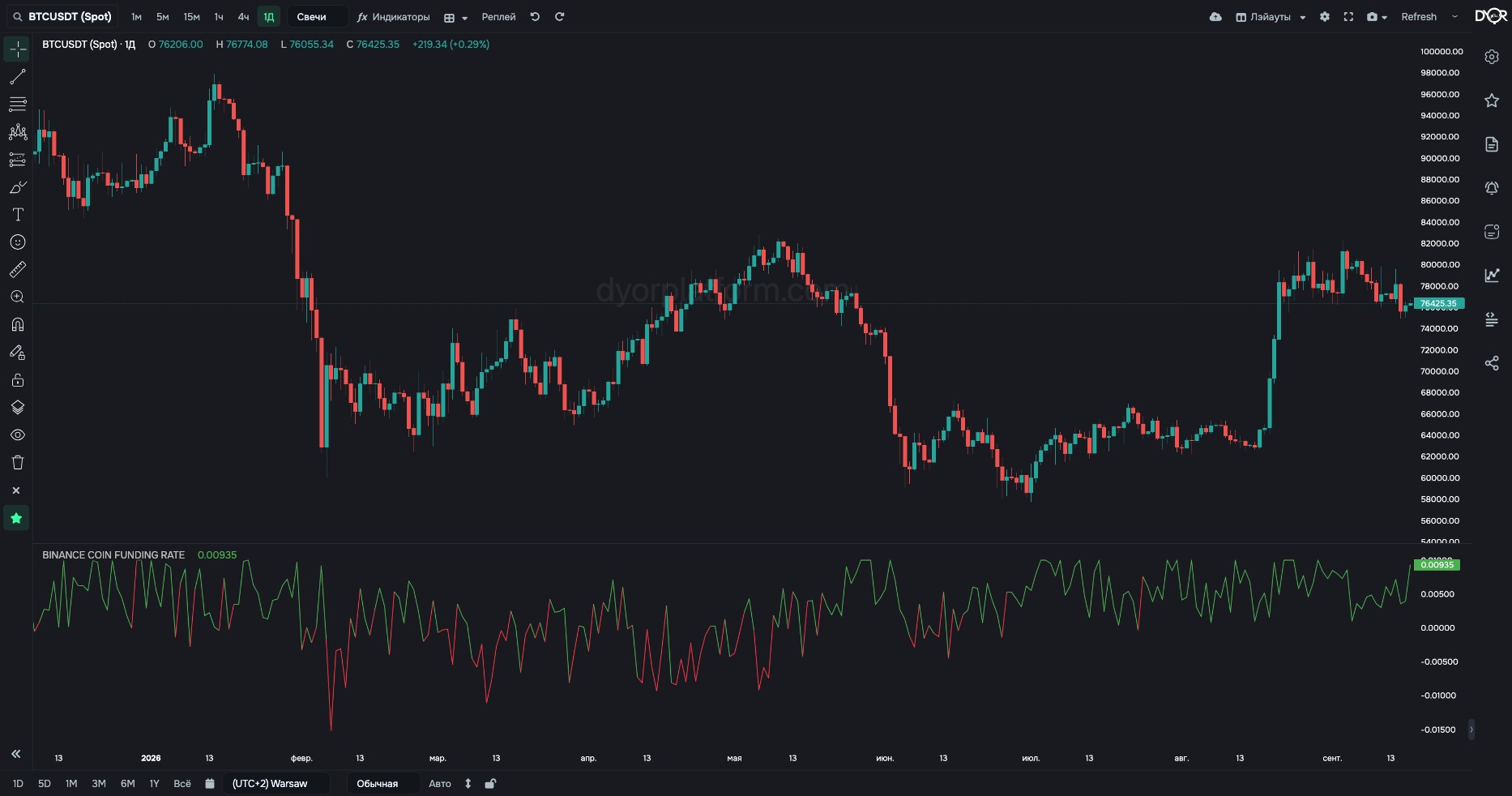
The funding rate on the coin's perpetual future.
Why funding exists. A regular future lives until a set date. On that date it is settled at the spot price. So by that date the futures and spot prices must converge, and the market pulls them together in advance.
A perpetual future has no date. It is never settled at spot. So nothing makes it converge: if everyone wants to go long, the future runs above spot and stays there, with nothing to bring it back.
Funding replaces that date. Once per period, the side that pulled the future away from spot pays the other side. Future above spot — longs pay. Holding a long gets expensive, holding a short pays. People sell the future, buy spot, collect the payments, and the future returns to spot. Below spot it is the other way around: shorts pay.
Without funding, a perpetual future would be a separate coin with its own price: you couldn't hedge spot with it, and liquidations would be calculated from a price unrelated to the market.
The rate is the size of this payment.
Three things. First — how much it costs to hold a leveraged position and who pays: this is the only indicator that is directly in money. Second — which side holds the leverage: the side pushing the future away from spot pays. Third — not mistaking high funding for a reversal signal.
For example.
Don't confuse it with LONG/SHORT RATIO. That one is how many accounts or how much money is long. This one is the futures price relative to spot. Many longs by accounts and positive funding are different things; one doesn't follow from the other.
In Workspace V2 the indicator is plotted only on the daily timeframe 1D. On 15m, 1h and 4h it shows “no data”.
There are no inputs — the “Inputs” tab is empty. Colors and lines are under Style.
Metric BINANCE COIN FUNDING RATE. Condition fields:
Funding is a periodic payment between longs and shorts on a perpetual future. It keeps the futures price near spot. Positive rate — longs pay, negative — shorts. Values are in hundredths of a percent per period.
The funding rate is positive — who pays?
Correct answer: Longs pay shorts
The rate is −0.05%. Who pays whom?
Correct answer: Shorts pay longs