 Learn hubBlog
Understand the difference between the COIN and TOTAL versions of indicators, the “Total type” and “Exchange” fields of TOTAL and the “BTC pairs” parameter.
Most indicators come in two versions.
Both versions share a name; only the prefix changes: COIN B&A → TOTAL B&A.
There are two more groups, briefly:
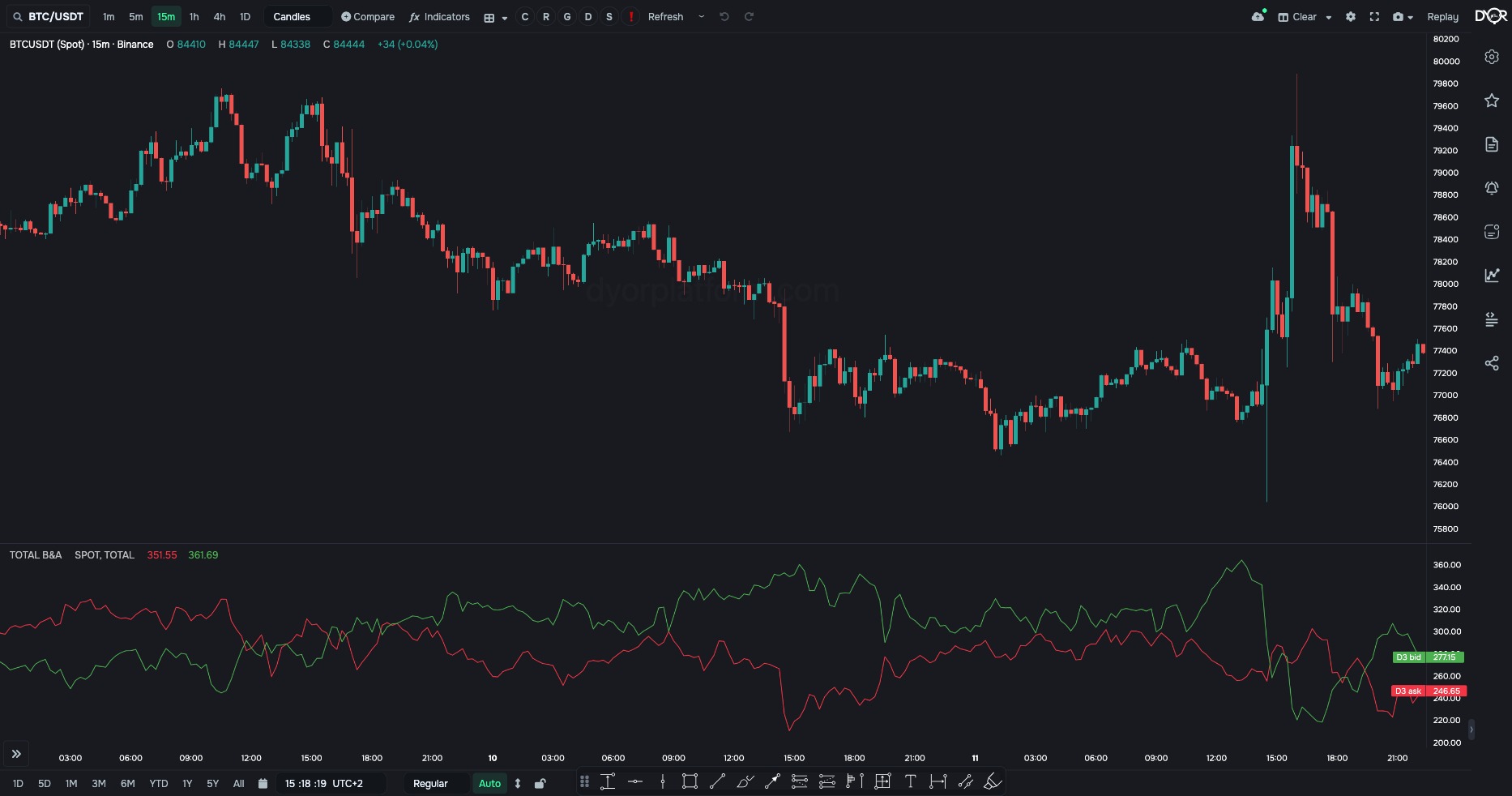
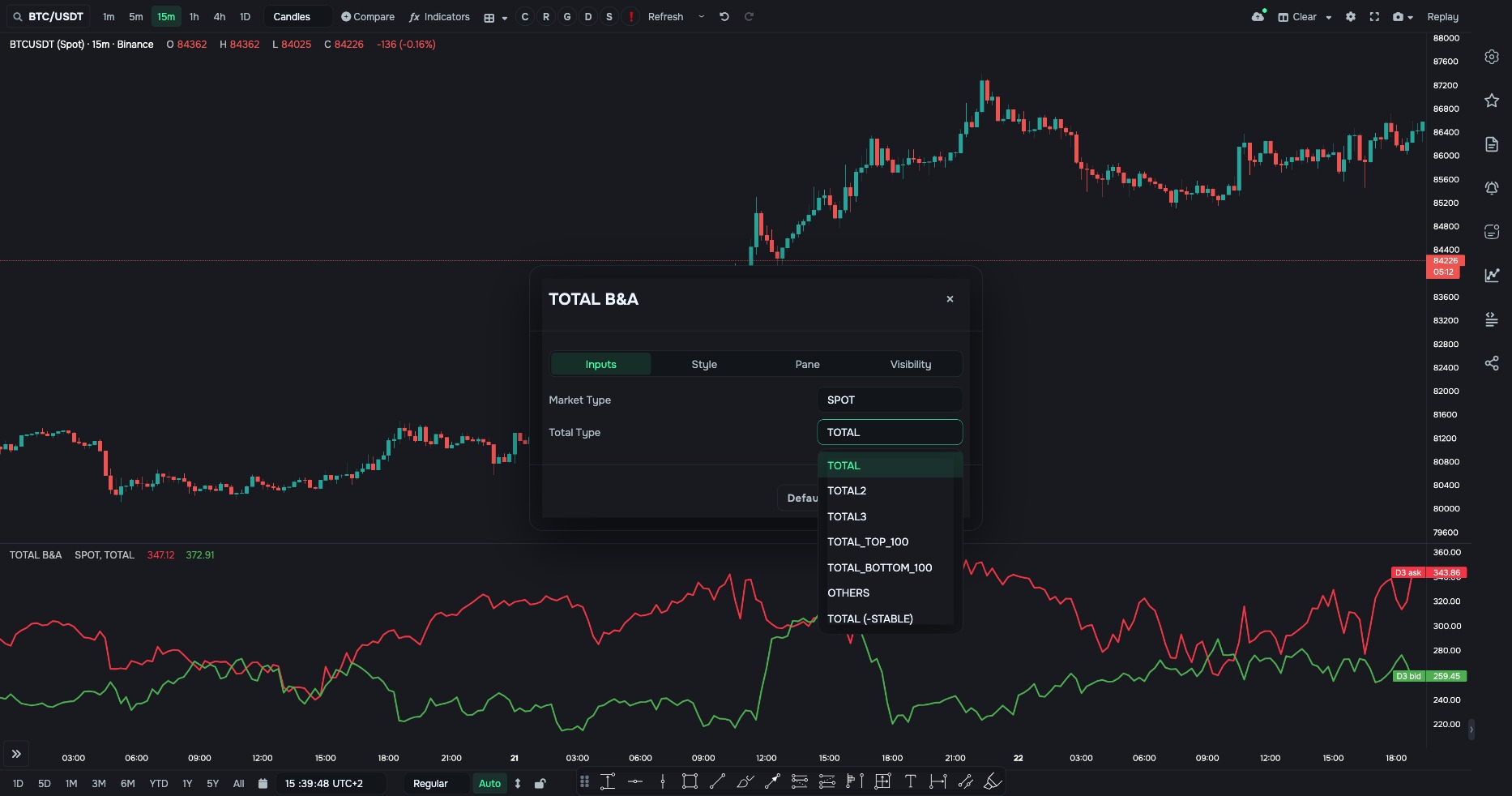
Every TOTAL version has this field in the “Inputs” tab: Total type. It picks which coins go into the sum.
Why it matters. BTC is the largest coin and accounts for most of the market cap. In an “all coins” sum it outweighs everything else. To see altcoins on their own, BTC is removed from the sum.
| Value | Coins in the sum |
|---|---|
| TOTAL | All coins. |
| TOTAL2 | All coins except BTC. |
| TOTAL3 | All coins except BTC and ETH. |
| TOTAL_TOP_100 | The 100 coins with the largest market cap. |
| TOTAL_BOTTOM_100 | The 100 coins with the smallest market cap. |
| OTHERS | All coins except the ten largest by market cap. |
| TOTAL (-STABLE) | All coins except stablecoin and fiat pairs against USDT: USDC, FDUSD, TUSD, USDP, USDS, USDE, USD1, BFUSD, XUSD, AEUR, EUR, EURI, USTC. |
A word on the last value. Stablecoin pairs such as USDCUSDT are dollars swapped for dollars, not the crypto market. But their volume and order book are large: USDCUSDT alone makes up about a quarter of the whole market's spot volume. TOTAL (-STABLE) removes these pairs from the sum. History covers the full depth of the chart. The same field exists in the Metrics Builder.
TOTAL OI and TOTAL OI DELTA have three options: TOTAL, TOTAL2, TOTAL3.
In alerts this field is called “Total type”. The values are the same: TOTAL, TOTAL2, TOTAL3, TOP 100, BOTTOM 100, OTHERS, TOTAL (-STABLE).
TOTAL indicators and market-wide ones (AGG. FUNDING, ASK BID ANOMALIES) have the field Exchange. By default it is Binance, not the chart’s exchange: the sum over the Binance market is built on any chart.
COIN indicators have the same field, but its default is “Same as chart” — details on the “Exchanges” screen.
On Binance, Bitcoin trades against three stablecoins: BTCUSDT, BTCUSDC and BTCFDUSD. The platform adds these three pairs up and shows them as one — BTCUSDT.
That's why COIN order book and trade indicators have the input BTC pairs:
The difference is noticeable: BTCUSDC accounts for about a fifth of Bitcoin's futures volume.
This concerns only Binance and only Bitcoin. For other Binance coins the data is always for the USDT pair. On Coinbase and Hyperliquid Bitcoin has one pair — BTC/USD and BTC/USDC — so the parameter does nothing there. On Deribit Bitcoin has two contracts, BTC/USD and BTC/USDC, but they are not added together: each has its own data.
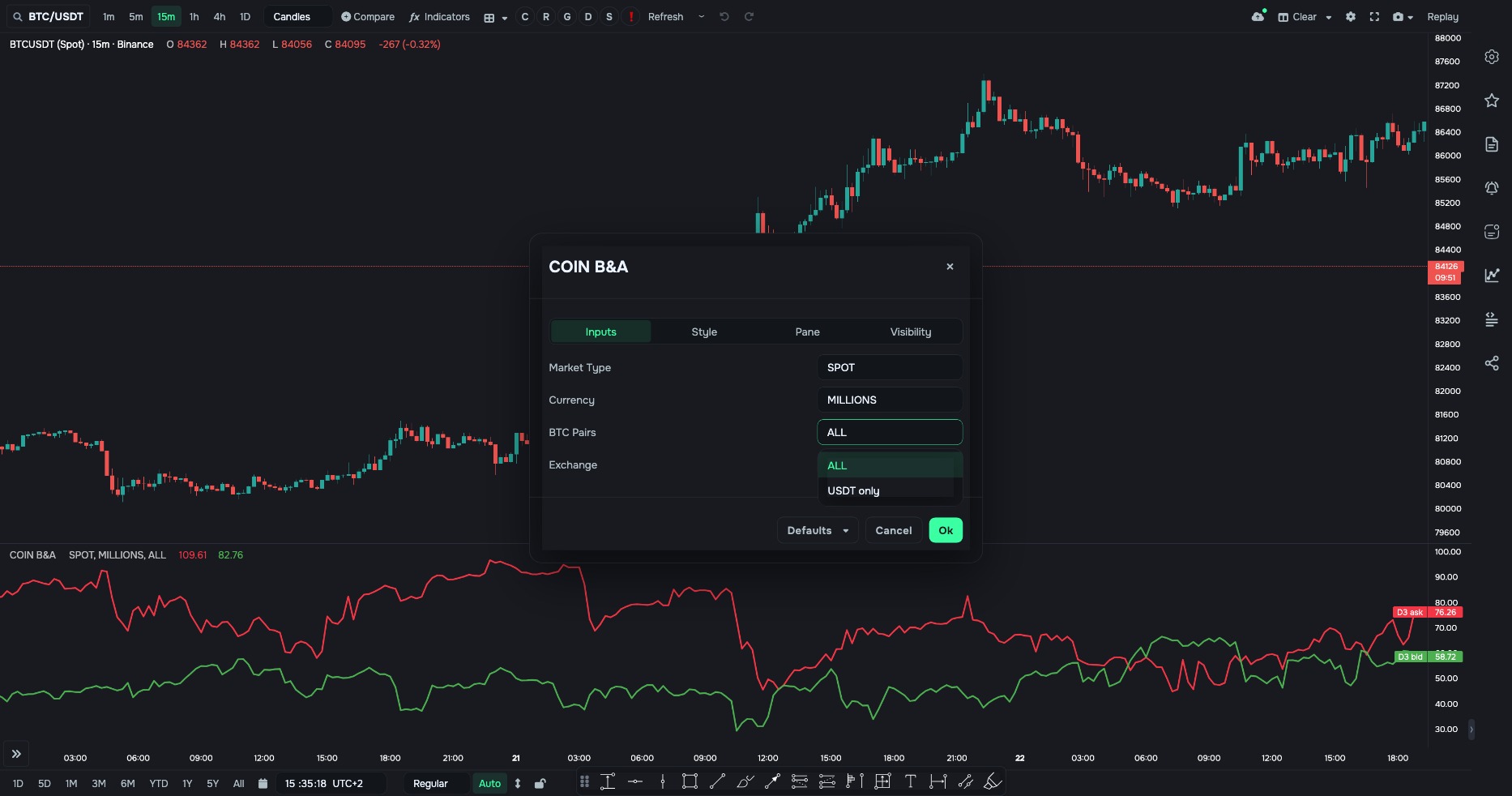
COIN is one coin. TOTAL is the same indicator summed over the market. “Total Type” picks which coins go into the sum: the whole market, without BTC, without BTC and ETH, the top 100, the bottom 100, without the ten largest, or without stablecoin pairs. TOTAL OI has only the first three. “Exchange” for TOTAL is which exchange’s coins to count, Binance by default. Bitcoin has its own “BTC Pairs” parameter: the sum of three pairs or pure BTCUSDT.
TOTAL3 is…
Correct answer: The market without BTC and ETH